Naturalization Interview Examples and Answers
A naturalization interview is not a test of whether you can give a perfect speech. It is your opportunity to show USCIS that the information in your N-400 application is accurate, that you meet the requirements for citizenship, and that you understand the oath you may take. Reviewing naturalization interview examples can help you feel prepared without making your answers sound memorized.
For many families, this appointment carries years of hope, work, and sacrifice. Feeling nervous is normal. Preparation can make the process more manageable, especially when you know which answers need a simple response and which situations require a closer legal review before the interview.
What Happens at a Naturalization Interview
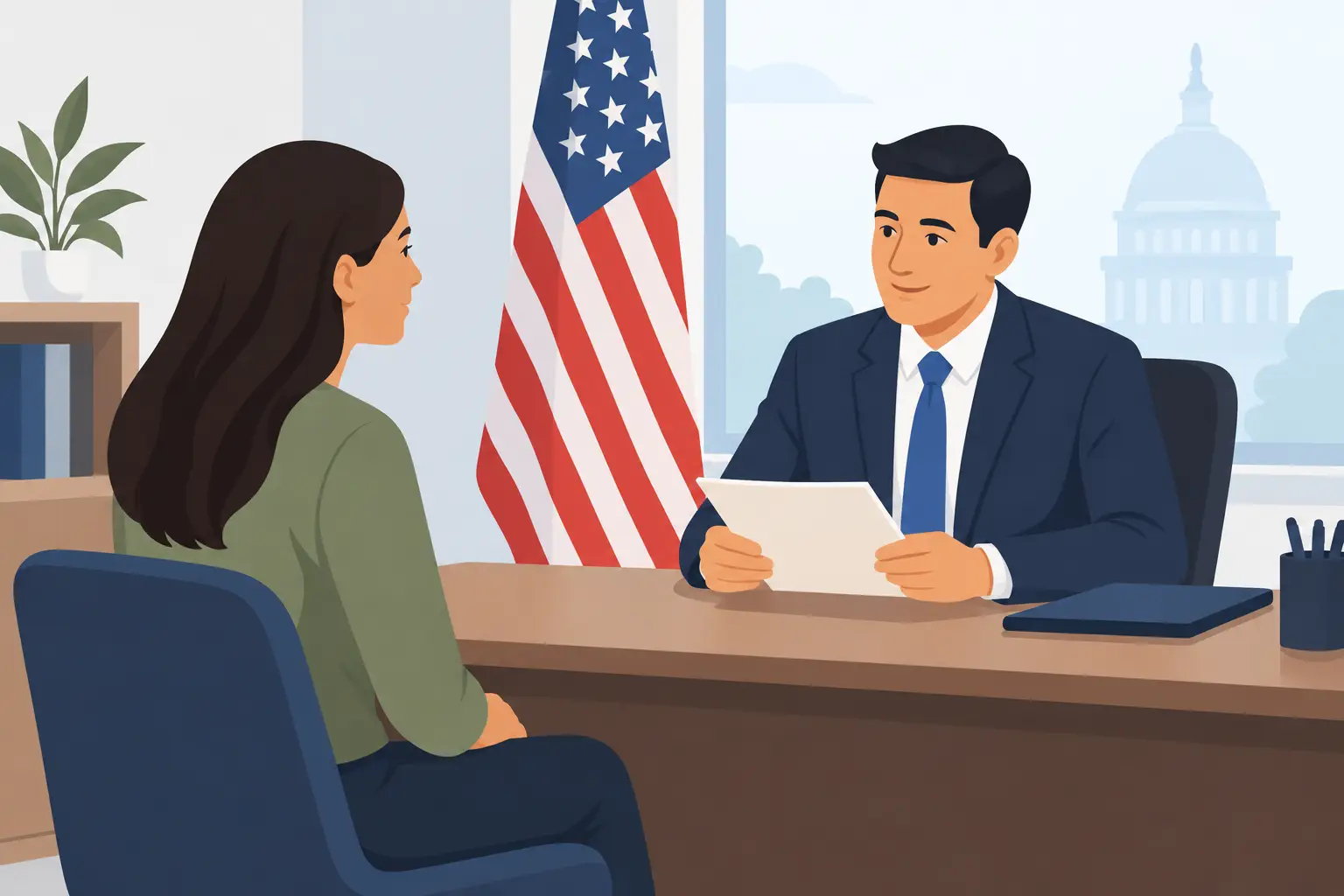
A USCIS officer will place you under oath and review your N-400 application with you. The officer may ask about your identity, your green card history, where you have lived and worked, your trips outside the United States, your family, your taxes, and questions related to good moral character.
Most applicants also complete an English test and a civics test during the appointment. The English portion generally includes speaking, reading, and writing. The officer evaluates your speaking ability throughout the interview by asking questions about your application. Some applicants qualify for an English-language exemption based on age and the length of time they have held lawful permanent resident status. Others may seek an accommodation for a disability when appropriate.
The officer may approve the case, continue it for more documents or another test opportunity, or identify an issue that needs further review. A request for more information is not automatically a denial, but it should be handled carefully and on time.
Naturalization Interview Examples: Common Application Questions
The best answers are truthful, direct, and consistent with your application and documents. Do not guess. If you do not understand a question, politely ask the officer to repeat or rephrase it.
Identity, residence, and travel
Officer: What is your full legal name?
Applicant: My full legal name is [name].
Officer: Have you used any other names?
Applicant: Yes. Before I married, I used [former name].
This question can include maiden names, names used in past marriages, spelling variations, or other names listed on prior immigration documents. Be consistent and bring documents supporting any legal name change.
Officer: Where do you live now?
Applicant: I live at [current address] in [city, state]. I have lived there since [month and year].
Officer: Have you taken any trips outside the United States in the last five years?
Applicant: Yes. I traveled to Mexico from [date] to [date] to visit family. I returned to the United States on [date].
USCIS may compare your answer with the travel history on your N-400, passport stamps, and other records. Short trips are often straightforward. Longer trips, repeated travel, or time abroad that may affect continuous residence should be discussed with an immigration attorney before the interview.
Family and marital history
Officer: Are you married?
Applicant: Yes. I am married to [spouse’s name]. We were married on [date].
Officer: Have you ever been divorced?
Applicant: Yes. My divorce from [former spouse’s name] became final on [date].
If you are applying based on marriage to a U.S. citizen, USCIS may ask more detailed questions about the marriage and whether you and your spouse have lived together. Bring the documents requested in your interview notice, along with evidence that supports the information in your application. If you are separated, recently divorced, or no longer living with your spouse, do not try to minimize the change. Your eligibility may depend on the details.
Work, taxes, and financial responsibilities
Officer: Where do you work?
Applicant: I work for [employer] as a [job title]. I have worked there since [date].
Officer: Have you filed your taxes every year you were required to file?
Applicant: Yes, I have filed my federal tax returns every year.
If you did not file a required return, owe taxes, or are on a payment plan with the IRS, be ready to explain honestly and provide proof of your efforts to resolve the issue. Tax issues do not always end a naturalization case, but they should never be ignored. A payment agreement and proof that you are following it may be important.
Questions That Need Extra Care
Some N-400 questions appear simple but can have serious consequences. An officer may ask whether you have ever been arrested, cited, detained, charged with a crime, or committed an offense for which you were not arrested. The officer may also ask about voting, claiming to be a U.S. citizen, selective service registration, child support, alcohol or drug-related conduct, and any contact with law enforcement.
A common mistake is believing that an old arrest does not matter because the case was dismissed, expunged, reduced, or happened many years ago. USCIS still expects a truthful answer. Do not answer “no” merely because there was no conviction. The right response may be, “Yes, I was arrested in [year]. The case was dismissed,” followed by documentation if requested.
Officer: Have you ever been arrested or cited by the police?
Applicant: Yes. I was cited for [issue] in [year]. The matter was resolved on [date], and I brought the court disposition.
Another sensitive example involves voting.
Officer: Have you ever voted in a federal, state, or local election in the United States?
Applicant: No.
If the truthful answer is yes, do not give a false answer out of fear. Voting, voter registration, or a false claim to U.S. citizenship can create serious immigration consequences. Get legal advice before the interview so that your application, supporting records, and response are handled correctly.
The same is true if you have a pending criminal case, recent DUI, unresolved child support issue, extended absence from the United States, or a prior immigration application that contains an error. These facts do not all lead to the same result. The details, timing, court records, and your immigration history matter.
Civics and English Test Examples
The civics test is based on questions from the official USCIS study materials. During the standard test, the officer asks up to 10 questions, and you must answer at least six correctly. Examples include:
- What is the supreme law of the land? The Constitution.
- Who makes federal laws? Congress.
- What are two rights in the Declaration of Independence? Life, liberty, and the pursuit of happiness.
- What ocean is on the West Coast of the United States? The Pacific Ocean.
For the reading test, you may be asked to read a short sentence such as, “Citizens can vote.” For the writing test, you may be asked to write a sentence such as, “The President lives in the White House.” The goal is basic English ability, not perfect spelling or advanced grammar.
Practice speaking about your own life in simple sentences. You should be able to state your address, work history, travel dates, marital history, and basic facts on your N-400. If English is difficult for you, practice regularly before your appointment rather than waiting until the week of the interview.
How to Prepare Without Over-Preparing
Read every page of the N-400 you submitted. If anything has changed since filing, such as a new address, job, trip, marriage, divorce, arrest, or child, be prepared to tell the officer. Bring originals and copies of the documents listed in your interview notice.
A practical folder may include your green card, state identification, passports, tax transcripts or returns, proof of marital status, certified court records if applicable, and evidence of resolved obligations. Keep documents organized, but do not hand over papers unless the officer asks for them.
Do not memorize answers word for word. Rehearsed answers can cause problems when the officer asks a follow-up question or phrases something differently. Instead, understand the facts and practice saying them clearly. If you need a moment to remember a date, say so. Accuracy matters more than speed.
Arrive early, dress neatly, and bring your appointment notice. If you need an accommodation or have a question about whether an interpreter may be permitted in your situation, address it well before the appointment. Do not miss the interview without taking prompt action, because a missed appointment can delay or jeopardize the case.
When Legal Guidance Can Protect Your Case
A routine naturalization interview may not require extensive legal preparation. But a short consultation can be especially valuable if you have an arrest record, tax debt, long trips abroad, a complicated marriage history, a prior removal issue, inconsistent information in past applications, or concerns about answers on the N-400.
Immigration Law Offices of Hadley Bajramovic PC has proudly served immigrant families for years and understands that an immigration concern can affect your work, your family, and your future. Before you take an oath to tell the truth at USCIS, make sure you understand what your record says and how to answer with confidence.